DFW · Austin · San Antonio
Permanent Christmas Lights — Installed Once, Never Taken Down
Red and green on December first without moving an inch. Warm white the rest of the year.
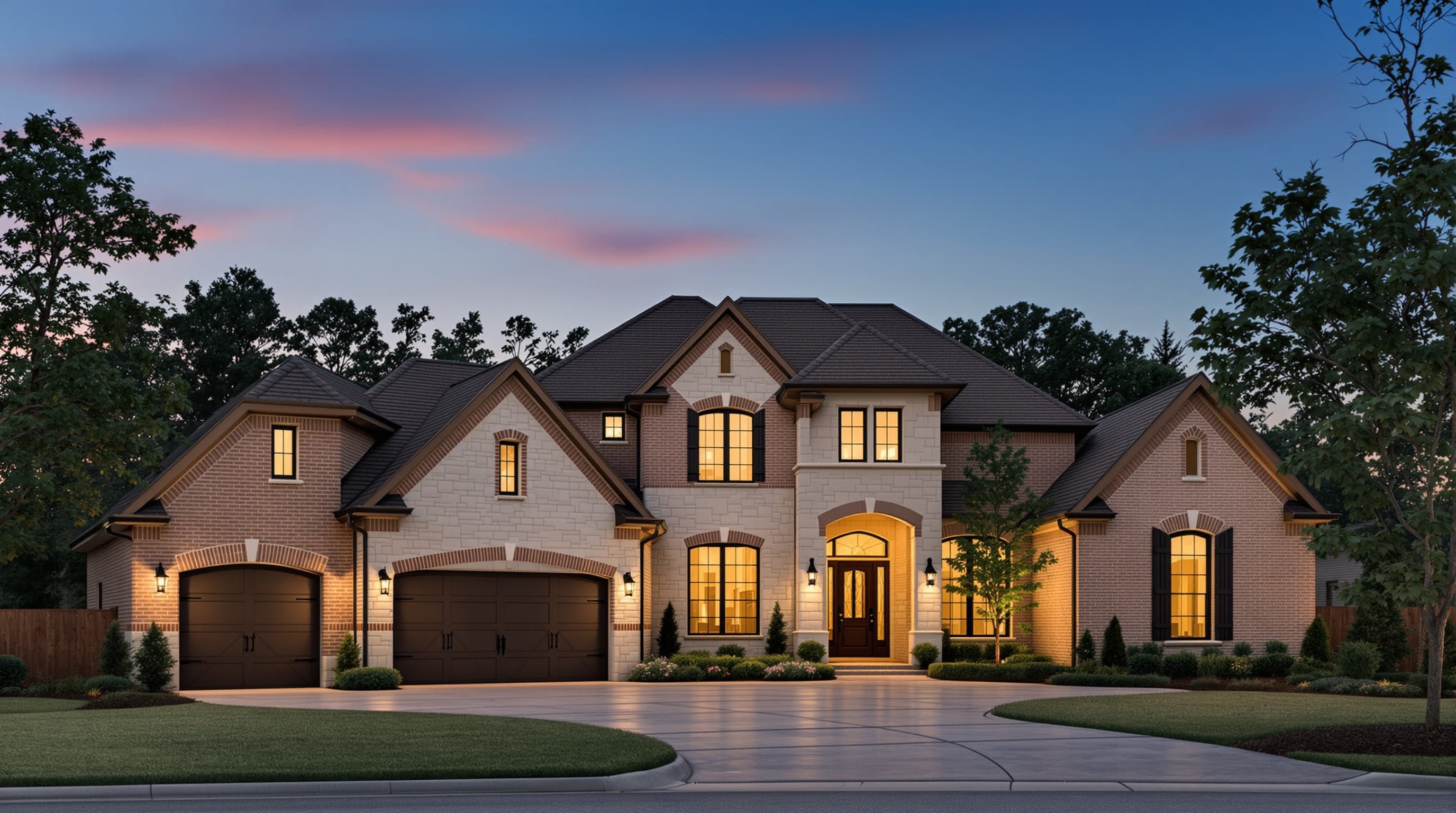
Permanent Christmas lights are a year-round LED system installed behind your roofline in a color-matched aluminum channel. Red and green on December first without moving an inch. Warm white for dinner parties the rest of the year. Cowboys blue when you want it. You climb the ladder exactly once — the day we install — and never again.
A typical Texas single-story install runs $2,500 to $5,500. Bulbs are rated for 50,000 hours with a lifetime product warranty. The system is programmable from an app on your phone and is completely invisible during the day, because the channel is mounted behind the gutter line and color-matched to your fascia. The cost calculator on this page gives you a real number for your home.
What they are
The version of Christmas lights that is also every other kind of light.
The name is a little misleading. Permanent Christmas lights are the same hardware as any permanent LED system — but they got the "Christmas" label because the holiday use case is what drives most homeowners to call. You want your house lit for December. Then you realize you can light it for Halloween, too. Then for game days. Then for dinner parties. Then you stop taking them down, and suddenly "permanent Christmas lights" is what you end up with.
Under the name, the system is four parts: a color-matched aluminum channel mounted behind your gutter line, commercial-grade LED bulbs inside the channel, low-voltage wiring running to a transformer box in your garage, and a smart controller that speaks to your phone. It replaces every temporary light setup you would ever install, because it does everything they did plus sixteen million colors and programmable patterns.
The reason it dominates holiday lighting specifically is that temporary Christmas lights are the single worst product in this whole category. They tangle. They have dead sections. They need extension cords that trip people. They blow fuses. They require a ladder. They last two seasons. And they look like temporary Christmas lights. The permanent version fixes every single one of those problems at once.
Why they matter
The ladder routine is worse than you remember.
Sit with the actual math. Two Saturdays stringing up in November. Every weekend in December checking for dead sections. A weekend in January taking them down. A shelf in your garage storing the tangled mess the other ten months. Replacement strands every two or three years because LED strands don't last as long as the marketing says. The occasional rented ladder, the occasional tweaked back.
Over 15 years, a family that does this seriously spends $4,500 to $9,000 in replacement materials and loses 300 to 600 hours of weekends. Most homeowners never add it up, because each year feels like $200 and a Saturday. The yearly cost is tolerable in isolation. The cumulative cost is ridiculous in hindsight.
A permanent system front-loads the cost and eliminates the time. Year four is typically when the numbers cross. Year five and forward, you are ahead in dollars and ahead by dozens of hours — and the light is better. The permanent version produces stadium-grade color palettes that temporary strands cannot match at any price.
What goes on your house
The exact opposite of a big-box Christmas strand.
The channel is extruded aluminum, powder-coated to match your fascia, and mechanically fastened into solid wood with stainless hardware. It is not adhesive. It is not clipped. It is installed the same way you would install permanent architectural trim — because that is what it is.
The bulbs are commercial-grade 0.6-watt LEDs rated for 50,000 hours at IP65 weather sealing. They produce a calibrated color temperature at warm white (3000K) and can shift to sixteen million addressable colors under program control. Each bulb is individually addressable — that is what makes the chase patterns and color gradients work.
The wiring is 12-volt low-voltage. Safe to touch. No fire risk. No permit required for replacement. The transformer sits in your garage or in a weather-rated exterior box, and the smart controller runs the app. You can schedule your holiday color change for November 27th at sunset without leaving your couch.
How it works
Four steps. One day. Every night after that.
- 01
Free on-site measurement
We come to your home, measure your roofline, review the architecture, and give you an exact quote — scoped to your home, not a ballpark from a spreadsheet.
- 02
Approval + HOA submission
Once you sign off, we prepare any HOA architectural review materials your neighborhood needs. Most Texas HOAs approve permanent LED systems on first submission.
- 03
Installation (typically one day)
The color-matched aluminum channel is installed behind your gutter line. Bulbs go inside the channel. Wiring runs clean. Most single-story Texas homes are done in a single day.
- 04
Activate your lights from your phone
We walk you through the app, set up your favorite presets, and hand off the system. Cowboys blue, warm white, holiday colors — all on tap from your couch.
Honest pricing
What would my home cost?
Adjust the sliders. See a real range. Then get a real quote.
A typical 2,400 sq ft single-story home has about 180 ft. A 5,500 sq ft estate closer to 400 ft.
Estimated install
Final quote after on-site measurement.
- Bulbs installed
- 540
- Annual electric cost
- ~$89/yr
The economics
When the math stops being a close call.
Year one, you paid upfront and you are behind compared to buying two strands at Home Depot. Year two, you have skipped the November install and the January takedown, and you didn't buy replacement strands, so the gap narrows. Year three, same. Year four, the cumulative cost of temporary lights plus labor plus replacement catches up, and you break even.
From year five onward, you are spending nothing and getting better holiday lighting than any strand at any price. In year fifteen you have saved thousands of dollars and hundreds of hours of weekends, and the system is still running on the same bulbs we installed the day we came out.
The cost calculator below lets you scale the payback to your home and roofline. The number most people are surprised by is the hours saved, not the dollars. Once you put an hourly rate on your weekends, the calculation is not close.
How we stack up
Lonestar Glow vs. the alternatives
| Feature | Lonestar Glow | Trimlight | JellyFish | Govee | Temporary lights |
|---|---|---|---|---|---|
| Stays up year-round | ✓ | ✓ | ✓ | ✓ | — |
| Invisible during the day | ✓ | ✓ | ✓ | Partially | — |
| 16+ million colors | ✓ | ✓ | ✓ | ✓ | — |
| App-controlled | ✓ | ✓ | ✓ | ✓ | — |
| Commercial-grade channel | ✓ | ✓ | ✓ | — | — |
| Professional installation | ✓ | ✓ | ✓ | — | — |
| Lifetime product warranty | ✓ | ✓ | ✓ | 1 year | — |
| Local Texas team | ✓ | Franchise | Franchise | — | — |
| Honest upfront pricing on site | ✓ | — | — | ✓ | ✓ |
Why Texas specifically
Holiday season runs long here.
In much of the country, holiday lights have a six-week window. In Texas, the season runs from the weekend after Halloween through mid-January — and for neighborhoods that go big, from October through February. That is four to five months of active use per year. The permanent system runs all of it without degradation.
The weather is the other reason this category exists in Texas specifically. Texas heat, Texas hail, Texas ice storms — the 2021 freeze turned an entire generation of big-box lights into landfill. What survived all three was commercial-grade, and commercial-grade is what we install. The lifetime product warranty backing the channel and bulbs is what allows us to make that claim in writing.
And Texas HOAs take home presentation seriously. In Plano, Frisco, Southlake, and the luxury pockets of Austin and San Antonio, neighbors notice. The permanent system wins HOA approval because it disappears during the day and appears beautiful at night — which is what those HOAs are actually optimizing for.
Where we work
Genuinely local on every street.
Related services
Learn more
Guides that help you decide.
The real pricing formula for Texas homes.
The financial case, the time case, and honest exceptions.
Every dimension compared side by side.
Three brands, honest verdict.
Different products at different quality levels.
50,000 hours rated. Here's the real-world picture.
Permanent Christmas Lights — Installed Once, Never Taken Down — the questions we get asked
A typical single-story Texas home runs $2,500–$5,500 installed. Two-story homes typically run $4,500–$8,500. Large estates on complex rooflines can run $10,000–$16,000+. Use the calculator below for a ballpark scoped to your exact linear footage and stories.
For homeowners who currently spend more than one weekend a year on temporary lights, yes. The payback is typically 3–5 years against replacement strands and labor, and the ceiling on what the system can do is vastly higher than any strand. For homeowners who only put up a small front-porch display, temporary lights may still be the right call.
They are off during the day. The app lets you schedule an automatic sunset-on and sunrise-off, so you never manually touch them. You can also create multiple schedules for different parts of the year — warm white from February to October, holiday colors during the season.
They do 16 million colors. Red and green on December first. Orange and purple for Halloween. Cowboys blue on Sunday. Warm white for dinner parties. Red, white, and blue for the Fourth of July. Every color and combination, programmable, from your phone.
Lifetime product warranty from the manufacturer on the channel and bulbs, plus a workmanship guarantee from us in writing. Individual bulb replacements are handled under warranty through year one, and available at parts cost after that. Storm damage claims are handled on a case-by-case basis — we usually replace bulbs under goodwill for the first few years.
The channel is fine — aluminum with powder coat is hail-resistant. Individual bulbs can take damage from direct hits in a severe storm, same as your shingles. The good news is that bulbs are replaceable individually in under a minute without removing the channel, so one hailstorm never takes down the whole system.
Ready for your free quote?
Free on-site measurement. Exact quote back to you within 24 hours.