10 Reasons to Install Permanent LED Lights on Your Texas Home
No more ladders. Warm-white accent lighting every night. Sixteen million colors on tap. The ten reasons Texas homeowners switch to permanent LED lighting in 2026 — ranked the way they actually matter after year one.
The first permanent LED system in a Texas neighborhood gets noticed. The second one sells itself to three more neighbors before Thanksgiving. After four or five years of installing these across Plano, Frisco, Southlake, Cedar Park, and Stone Oak, we've learned that the reasons homeowners give before they buy and the reasons they give after they own the system aren't always the same — so this list covers both.
Here are the ten reasons Texas homeowners install permanent LED lights in 2026, ranked roughly in the order that turns out to matter most one year after install.
You never climb a ladder again
The single most under-rated benefit of permanent LED lighting is the one that doesn't show up on a spec sheet: you're done with the ladder. Permanently.
Hanging temporary Christmas lights on a 2,400-square-foot Texas home takes 8–16 hours per year once you count putting them up in November, taking them down in January, testing strands, troubleshooting dead sections, and the inevitable mid-December emergency trip up to fix the run over the garage. That's two to four full weekends a year. Over fifteen years, it's 120–240 hours on a ladder.
Falls from ladders are the leading cause of serious home-maintenance injury in the US for adults over 40. That's not a scare-tactic stat — it's why more homeowners in their 40s and 50s are making this switch. Permanent LED lights cut that annual ladder time to zero. The install day is handled by professionals. After that, you change the color from your phone.
Sixteen million programmable colors, scheduled from your phone
Temporary Christmas lights come in three flavors: warm white, multi-color, or whatever mix you cobbled together from three different boxes at Lowe's. That's it. Permanent LED lighting works differently. Each bulb is an individually addressable RGB-plus-warm-white LED, capable of producing any of 16 million colors on demand.
Every bulb can be a different color simultaneously — which is how these systems produce chases, gradients, dancing patterns, and multi-color holiday scenes temporary strands physically can't do at any price. On game days in Allen or Southlake, the roofline runs maroon or burnt orange. On July 4, it alternates red, white, and blue. At Christmas, it runs classic red-and-green or cool-white-only or a shimmer effect — whatever you pick from the app.
The scheduling is where the app genuinely earns its keep. You set sunset-on, bedtime-off, and the system takes it from there — adjusting sunrise and sunset times automatically as the Texas seasons shift. No timer box in the garage. No walking outside to flip a switch. No coming home to a dark house because you forgot to plug the extension cord back in.
Warm-white accent lighting every night of the year
This is the reason homeowners didn't know to expect but rank highest after they've lived with the system for a year.
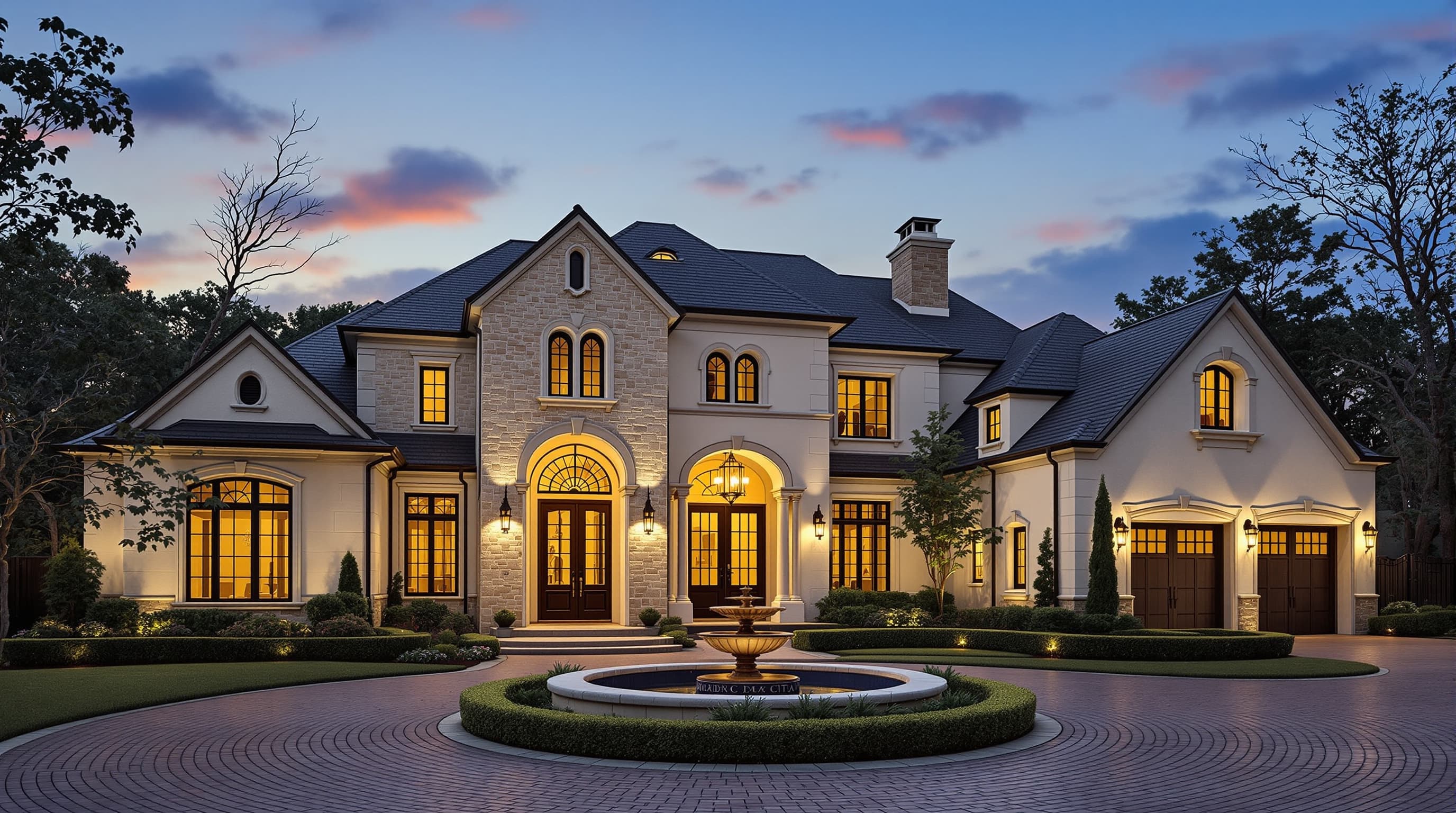
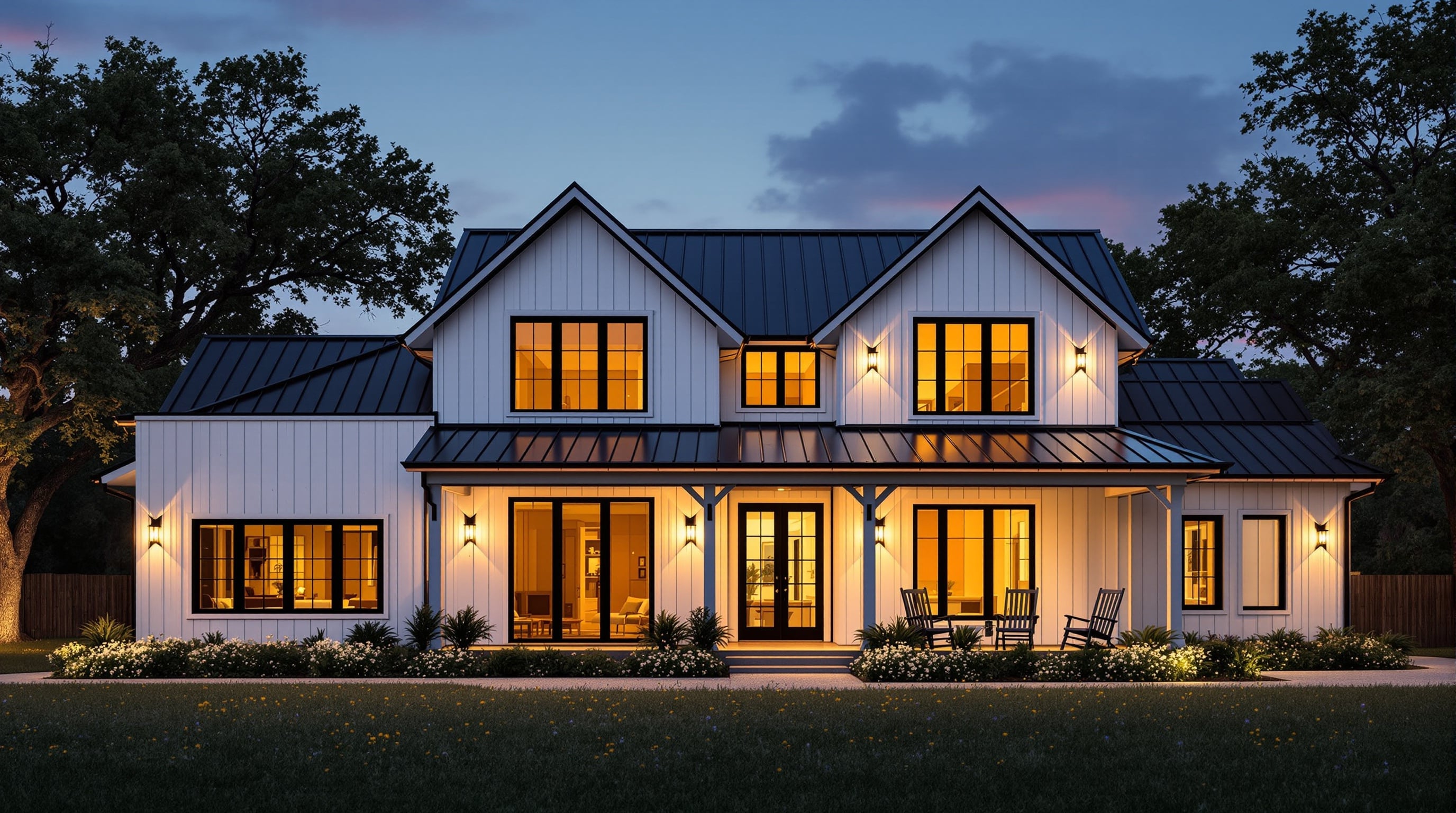
The default daily mode for permanent LED lighting isn't holiday colors. It's a soft, architectural warm-white wash along the roofline — the kind of lighting you'd normally pay a landscape-lighting specialist five figures to install. It runs every evening from sunset until whatever time you schedule lights-out. It adds dimension to the facade, highlights the rooflines, and makes the house look like it belongs in a real-estate photo.
Homeowners tell us the same thing across every suburb we serve: they bought the system thinking about Christmas and ended up using the year-round warm-white mode far more than the holiday scenes. On a Tuesday in March, the house glows. That's the feature.
The hardware disappears during the day
The number-one objection we hear from homeowners before an estimate is some version of "I don't want my house to look like a Griswold project in July." Completely fair.
Professional-grade permanent LED lighting is designed to be invisible during daylight hours. The bulbs sit inside a slim extruded-aluminum channel that mounts behind the gutter line, color-matched to your fascia in white, cream, bronze, or black. From the street, in daylight, most homeowners can't point to where the channel is even when they know it's there. No clips. No wire runs. No extension cords across the flowerbed.
This is why HOAs in Plano, Frisco, Prosper, Southlake, and most Austin and San Antonio suburbs approve professional systems on first submission. The hardware is architectural trim, not a decoration.
One system covers every holiday — not just Christmas
If you only thought of this as "permanent Christmas lights," the value proposition is narrower than it actually is. The same system handles every seasonal lighting need you have in a given year:
- Christmas — red-and-green, warm white, multi-color, or cool white with animation scenes
- Halloween — orange with purple accents, or full orange chasing patterns
- Thanksgiving — warm amber and rust-red transitions
- July 4 — red, white, and blue alternating or shimmer
- Valentine's Day, St. Patrick's Day, Easter — pick a color, tap, done
- Game days — school colors, Cowboys blue, Longhorns burnt orange, Aggie maroon
- Birthdays, parties, anniversaries — whatever the occasion calls for, in thirty seconds
The math gets more persuasive when you count how many different strand sets the permanent system is replacing. Most active decorators have Christmas lights, Halloween lights, and maybe July 4 strands in the garage. All three sets — plus the storage bins, plus the clips, plus the extension cords — go away.
Built for Texas weather, not a December in Minnesota
Residential Christmas light strands are built to a price point for a market that uses them four to six weeks a year. They're not designed for 110°F July attics, UV exposure year-round, 60-mph spring storms, or hail. Texas homeowners who try to leave temporary strands up year-round learn this the hard way — the plastic goes brittle in one summer, the clips crack, and the connections corrode.
Professional permanent LED systems use commercial-grade hardware designed for continuous outdoor exposure. The bulbs are IP65-rated (sealed against rain and dust), the channel is powder-coated aluminum (no rust, no UV degradation for 15+ years), and the wiring is sunlight-rated. The same systems we install on homes in Texas are installed on hotels, commercial campuses, and hospitality venues that can't afford to have sections fail.
When a severe hailstorm rolls through DFW or the Hill Country, the individual bulbs can take a direct strike — but the channel itself protects most of them, and any bulb that fails is replaceable in under a minute without disturbing the rest of the run.
Curb appeal and home value
Ask a listing agent in Southlake, Westlake, or Stone Oak what's trending in affluent Texas real-estate right now and permanent outdoor lighting comes up alongside upgraded outdoor kitchens and whole-home generators. It's not an appraised dollar figure — it's a differentiator at the listing stage.
For dusk showings, a well-lit home reads as cared-for, intentional, and finished. For daylight showings, the clean fascia with no visible hardware reads as architectural. Either way, the system conveys with the house at sale — you're not taking it with you — so the buyer gets the feature already installed, and you get the curb-appeal boost for every day you own the home plus a cleaner closing.
Security lighting that doubles as architectural accent
Dusk-to-dawn lighting around the perimeter of a home is one of the most consistently effective residential-security features — more so than cameras in most studies. A lit home is a harder target than a dark one.
Permanent LED lighting makes perimeter lighting effortless. Schedule it to run sunset-on and sunrise-off at full warm-white output, or schedule lower intensity overnight. The same system that produces holiday color scenes in December is producing quiet, continuous perimeter illumination 365 nights a year — without the operational hassle of separate motion-sensor floods that false-trigger every time a cat walks by.
Energy-efficient — and cheaper to run than most homeowners expect
A common concern before install: "Isn't it going to jack up the electric bill?" It won't.
Each permanent LED bulb draws roughly 0.6 watts. A typical Texas single-story home runs 180–260 bulbs. At five hours per night, the annual electricity cost to run the whole system comes out to about $18–$32 per year, depending on your utility rate. That's cheaper than a single season of the temporary strands you'd otherwise buy, clip, and plug in.
Compare that to traditional incandescent C9 bulbs (5–7 watts each) running on a 200-bulb roofline and you're looking at 10x the power draw for less control and a two-season lifespan. The efficiency isn't marketing — it's the reason these systems became viable in the first place.
50,000-hour rated lifespan and a lifetime warranty
The LED bulbs in a professional-grade permanent lighting system carry a 50,000-hour L70 rating — the point at which the bulb's output has declined to 70% of new. At five hours of nightly operation, that's 27.4 years. At three hours per night, which is closer to the average homeowner's actual use, it's over forty-five years.
The aluminum channel doesn't wear — aluminum doesn't rust, and the powder coat holds up for 15–20+ years of UV exposure without meaningful degradation. Professional installs come with a lifetime product warranty on the hardware (for as long as you own the home) plus a workmanship guarantee on the install itself. If a bulb fails in year one, it's covered. If a run fails because of how we mounted it, we fix it on our dime.
The math works out to a single purchase that replaces every annual temporary-light expense, every stretch of ladder time, and every run to the hardware store for one more extension cord — for the life of the house.
The honest section: who shouldn't install them
We've turned down a handful of quotes over the years where permanent LED wasn't the right call. If any of these describe your situation, save the cash:
- You're selling in under three years. The system conveys with the house, but the payback math doesn't fully close before you move.
- You don't decorate for the holidays and won't use the year-round mode. A handful of homeowners fall in this bucket — the economics don't justify the install.
- Your fascia is in poor repair. We flag this during the site visit. Fix the wood first, then come back.
- Very specific modern flat-roof or parapet-wall designs where there's no clean mounting surface. Rare, but real — we'll tell you honestly if your home falls here.
If none of those apply, the system pays for itself, saves weekends, and makes your home look better 365 nights a year. That's the case, in ten parts.
What your home would cost
The calculator below uses our actual pricing formula, scaled to linear footage, stories, and roofline complexity. It gives you a real range in thirty seconds — not a vague brochure number.
Honest pricing
What would my home cost?
Adjust the sliders. See a real range. Then get a real quote.
A typical 2,400 sq ft single-story home has about 180 ft. A 5,500 sq ft estate closer to 400 ft.
Estimated install
Final quote after on-site measurement.
- Bulbs installed
- 540
- Annual electric cost
- ~$89/yr
Ready to see what this looks like on your house?
The free on-site measurement takes 20–30 minutes. We walk your rooflines, measure linear footage, confirm the channel color against your fascia, and hand you a fixed-price quote before we leave. No subscription, no pressure, no pulling up in a pickup with a magnetic sign on it.
Schedule your free estimate, or read the full 2026 cost guide and the honest worth-it breakdown before you call.